
My granddaughter, Holland, just got a new pair of sneakers. She looks down at her feet and marvels that just fourteen months before her feet were tucked in the fetal position. Okay, maybe she can’t recall those moments in the womb before she burst into the world like shimmering sunlit foil. So I imagine for her, and think about how miraculous it is to be dancing with new shoes that you love so much that you can’t look up. Her shoes float and skip across our wood floors accompanied by her happy coos. I am struck by the realization that I love this child deeply, even as she stares down at her shoes, unable yet to express with words the joy she feels while dancing with new shoes.
Love is a funny thing. People say that God is love, but what if we have that backwards? Perhaps Love is God? And all the things that define love have always been and will always be. And if that is so, then love must have another someone. It cannot be what it is, alone. Which makes me wonder about life and its many curves, some of which we don’t quite make, as we spin off the road and into the ditch. I don’t know how to explain this, but sometimes I sense a camaraderie with people I have never met in places and times that I’ve never lived. Thoman Merton lived a portion of his life as a Trappist monk, in a Bardstown, Kentucky monastery. However, he writes as one who always understood that life was not a solitary venture. Merton writes about a moment in his life when he saw people differently, even though he did not know them. “In Louisville, at the corner of Fourth and Walnut, in the center of the shopping district, I was suddenly overwhelmed with the realization that I loved all those people, that they were mine and I theirs, that we could not be alien to one another even though we were total strangers. It was like waking from a dream of separateness, of spurious self-isolation in a special world, the world of renunciation and supposed holiness. The whole illusion of a separate holy existence is a dream.” Thomas Merton, Conjectures of a Guilty Bystander
And if someone has this universal sense of loving strangers, how much more is possible in loving those to whom we are near. A few summers ago, Karen and I drove up into the Adirondack Mountains, on our way to Canada to see our son in Toronto. We stopped at Old Forge near the Moose River, succumbing to the siren call of the dairy shack with the roof top ice cream cone the size of a Buick. Summer in upstate New York takes me back to memories of books like A Separate Peace. As we drove toward Canada along interstate 84, I listened to my wife’s commentary as she browsed through a box of family letters and pictures that turned up after her mom had cleaned out the house in New Jersey before selling it and moving to Arizona. Karen read a letter written from her mother to her husband Thom, who was serving as an Army Reserve cook at Fort Drum, NY, in 1957. Thom’s bacon and egg breakfast, a skill perfected in the Army Reserve, was legendary for the five Mason children. Karen had always wondered where Fort Drum was. She looked up from her letter and saw a green highway sign not far from the Canadian border just east of Lake Ontario. It was an exit sign for Fort Drum.
Then, she came across this picture of her dad at the age of 16, taken not long after he was involved in a car wreck. He appears dazed, unsure. He and some buddies had raided a watermelon patch. The farmer chased them out of the field. Thom had been riding shotgun, front passenger, but his buddy got there first, piling back into the getaway car.

His friend died in the wreck shortly after they had left the scene. Thom was fortunate, he would never have become a father, and his children would never have raised children, and so on, if he had occupied the front seat.
It is a wonder that we are who we are. Virginia Woolf says that, “Memory is the seamstress…”, and these moments in time seem to be disconnected fragments, “…hanging and bobbing and dipping and flaunting, like the under linen of a family of fourteen on a line in a gale of wind.” I prefer to think about those disconnected fragments of our lives, flaunting about in the breeze, as a story with meaning, and power, with places and memories that weave themselves into the fabric of our family like dancing energy. Indeed, life is a dance, according to C.S. Lewis, and “God is not a static thing, but a dynamic, pulsating activity, a life, almost a kind of drama.”
I see this drama when I watch my grandchildren. It seems absurd for my granddaughter to find her new shoes glorious, and just as absurd that despite the foibles and failures and stupid things I have done in my life, she loves me. If I could, I would tell her how beautiful she is. But she can’t understand yet, and perhaps neither can I, or really any of us. Most of us are unaware, gazing at our shoes while mumbling what seem to be words, while love’s glory shines down upon our feet like morning sun.
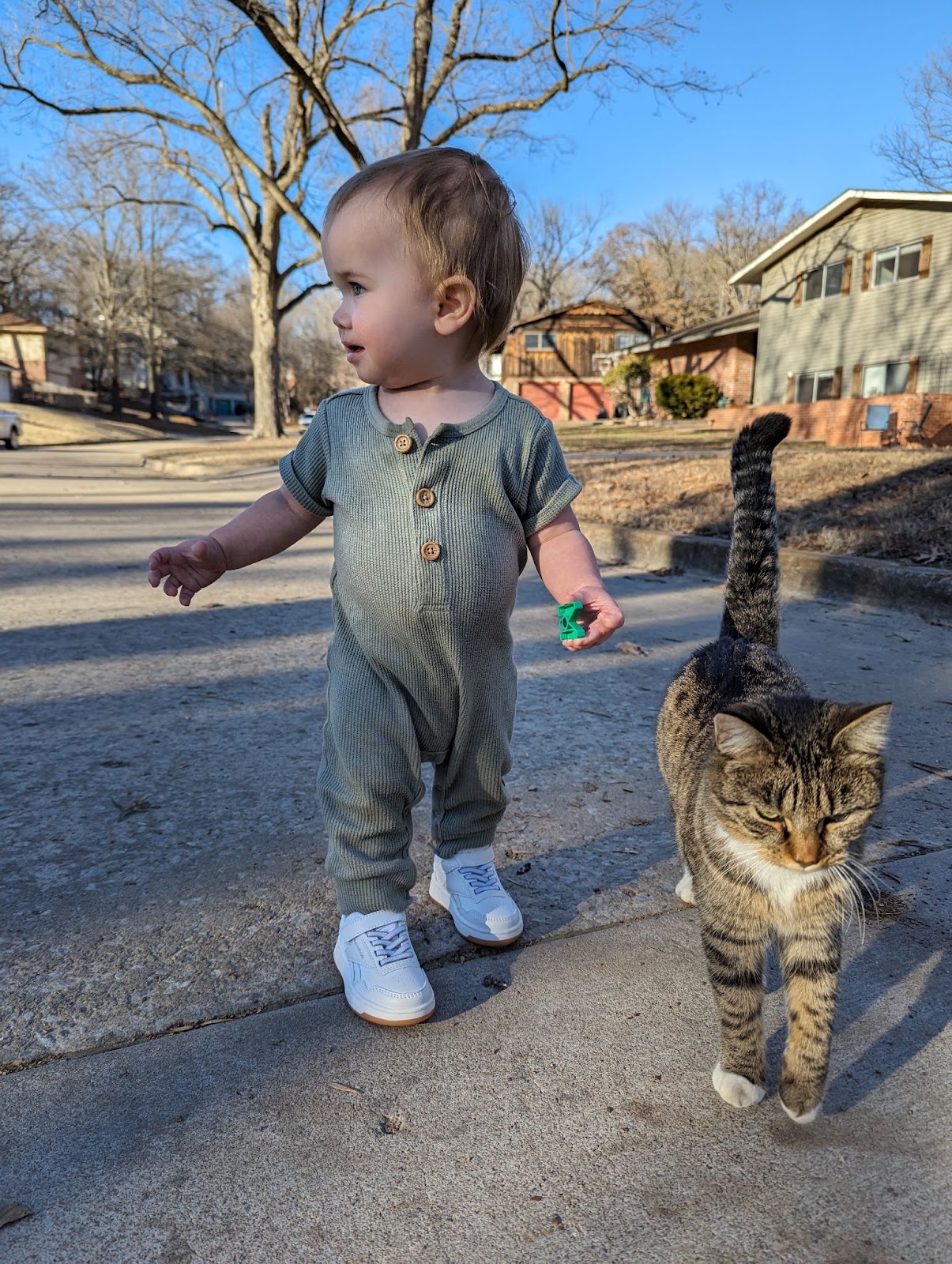
Dear Holland:
One day you will know how much I love you, probably when I’m long gone, and you are still here reading about your Great Pop-Pop, who spun off the road and into the ditch but survived. I’m thankful that he survived so that you can dance. Go, make the world a better place, help people you know and those you don’t, plant flowers in the gardens of others, paint pictures, find people and make them laugh. Love and learn, live and play with an abundance of joy. One day your shoes will be worn and beyond repair, but it will be worth it. Keep dancing until you can’t anymore. You will be amazing!
I love you,
Your Bubs
 Bespoke