
1935
The story Dad told that I had never heard was about his dad and Mickey Mantle’s twin brothers. It wasn’t so much a story as it was a brief wistful lament.
Koufax and Gibson were both born in 1935, the same year Dad was born. We were coached by dads born during a hardscrabble era when life was difficult, and baseball was played in farm fields on Saturdays and home plate was an oak tree and 2nd base the hubcap of a 1946 Desoto.
The fathers that weren’t coaching, leaned against the backstop and encouraged us, yelling mostly good things, sometimes things we didn’t need to hear, but all from the perspective of their own upbringing, as sons of the Depression.
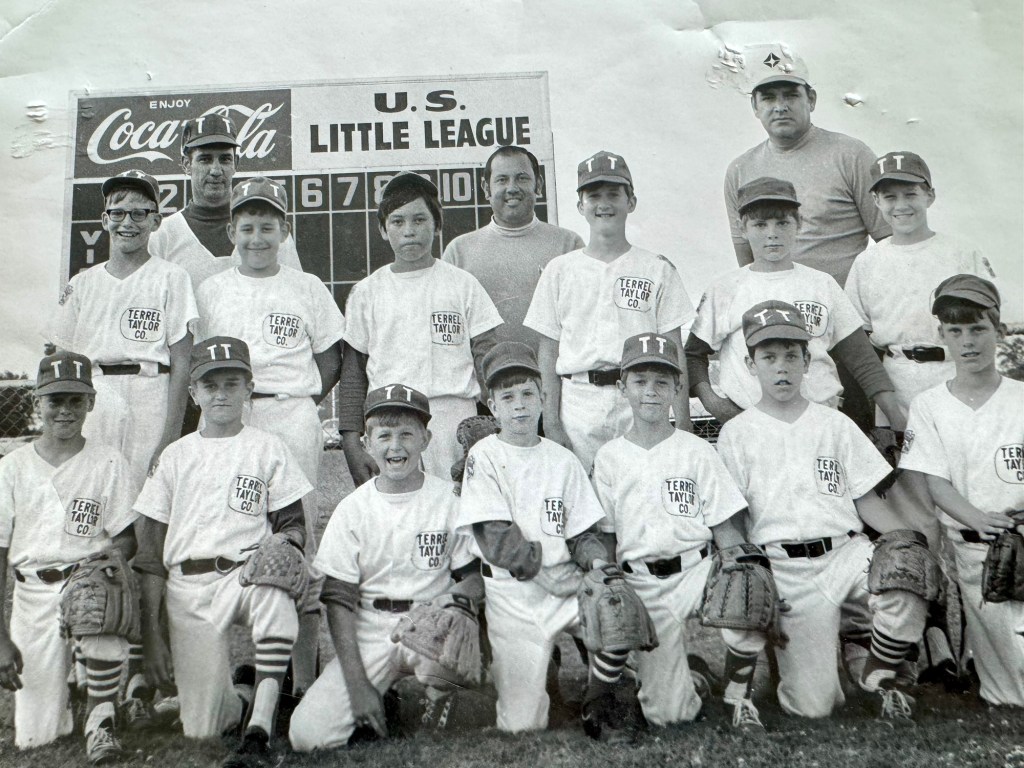
We now wore the names of their companies across our chests, Redbird Ranch, National Zinc, Terrel Taylor Company, Hopper Homes, May Brothers, McDonald Auto Parts, as they leaned into our world of competitive baseball that seemed to be the most important thing in the world to us at the time.
Dad & Mickey Mantle
Dad was a storyteller, and during his sunset days, he often surprised me with a story that I had never heard. He was lamenting his failures as a dad, and he mentioned wistfully that his dad had never seen any of his Bluejacket High School baseball games. Dad’s Bluejacket team played against Commerce, OK and Mickey Mantle’s twin brothers, Roy & Ray Mantle. Ross Taylor, my grandpa, was affectionately called daddy by his children, even when they were adults. I can’t imagine my dad feeling a particular sort of resentment toward his dad because he did not come to his games. Those were hard times though, and I’m sure Grandpa Ross was busy providing for his family. But Dad was noticeably wistful regarding his dad’s absence from that part of his life.
That summer of ‘71, twenty years after dad played against the Mantle twins, a Taylor and Mantle would cross base paths once again during the Oklahoma State Little League Championship. Commerce and Mantle beat the Bartlesville 12-year-old U.S. All- Stars that year, despite my line drive single to right field off Mickey Mantle’s nephew. But this is a story not so much about that game, but rather the game that advanced us to the finals, a game against the Bartlesville American League All-Stars.
The most memorable moment for me was a game clinching play at 2nd base that has ever since framed my view of a Bartlesville baseball legend, Tug Baughn. I would often bump into Tug around town in later years when he had retired from coaching the Bartlesville American Legion baseball team. He told me several times that if I had continued to play baseball, that he would have brought me in from the bullpen to throw my curve ball behind all the flamethrowers he had on his staff. I somehow believed him because of what happened in our semi-final game.
I was pitching and we were up by a run in the final inning against the American League All-Stars.
Tug strolled to the mound and Mark Boyd, my catcher, joined the discussion. Ed Johnson, who later became my teammate on the Bartlesville College High Basketball team along with Boyd, stood on first base glaring at me, fresh off ripping a single up the middle.
The cleanup hitter, Rick Owen, who later played American Legion ball for Coach Baughn, was strolling to the plate. “Bust him inside with a fastball and then work the curve to the outside corner,” Tug told me. Instead, I grooved a fastball and Rick ripped a shot to the gap in left centerfield.
My heart sank when Rick drove that ball to the fence. Ed Johnson was rounding third now, headed for home. The ball was relayed from center field towards home plate. I knew it was offline, so I cut it off and threw to Stan Baughn at 2nd base who alertly tagged out Rick for the final out.
We were heading to the state finals! I turned and began to jog toward our dugout and that is when I saw Tug Baughn running toward me across the third baseline and neither one of us knew quite what to do. Those were days when guys didn’t hug. He stuck his arm out and patted me on the back as I jogged past. I had never seen Coach so happy.
Mark Boyd and I have traded correspondence and caught up with one another and after all these years, I wondered if he remembered about those games. So, I emailed him and asked if he remembered that game. Here is what he said.
“Yes, I remember catching you in the All-star game. You were the first pitcher I caught that had a curve ball that curved. As a matter of fact, coach Baughn emphasized to me to be ready to block any curve balls from you that might bounce into the dirt. When I caught you, I consciously shifted my weight a little bit to the right in my catcher’s stance so I could get to a ball in the dirt quicker. I was cheating a bit to make sure nothing went by me. Funny how I can remember those details. I also remember playing Mantle and Commerce. You were always a heady athlete so having the situational awareness to cut the ball off and throw to second sounds exactly like something you would do. Of course, I was probably shouting to cut and throw to second because that would have been my responsibility as a catcher.”
Mark Boyd
All the Kings’ Horses and All the Kings’ Men
I think about baseball less and less these days, but I still fondly remember those halcyon days from the summer of ‘71 when the sky was cornflower blue and the baselines freshly chalked, the air scented green from newly mown grass. Anything was possible at twelve years old, even a trip to Williamsport and the Little League World Series. Yet, our dreams were shattered when we lost the Commerce game.
Years later I came to understand more deeply what I felt at the age of 12, while watching the movie Field of Dreams, as Ray Kinsella had a catch with his resurrected dad on a diamond in the middle of an Iowa cornfield.
I never had as much fun playing baseball later on as I did that summer. Most of us rush through our best moments without acknowledging their meaning. Conversely, we are often prone to dwell on moments that leave us broken and scarred.
In the movie, Field of Dreams, Shoeless Joe Jackson, before disappearing back into a field of Iowa corn, asks Ray Kinsella, “Is this heaven?” Ray responds, “No, it’s Iowa.” Most of our fathers from that 1971 team have parted the corn and joined Shoeless Joe and John Kinsella in that mysterious place beyond outfield. But they live on in their sons and daughters on a thousand ball fields, answering the hopeful question, “You wanna have a catch?”
I was listening to a podcast recently about the things we break and the ones we can’t fix. (“All the Kings Horses”, This American Life, March 24, 2024)
These include our relationships and how they sometimes seem hopelessly beyond repair. There is a nursery rhyme we heard often as children.
Humpty dumpty sat on a wall,
Humpty dumpty had a great fall,
All the kings’ horses and all the kings’ men,
Could not put Humpty Dumpty together again.
Apparently, children nowadays find this nursery rhyme frightening. Now that I think of it, perhaps it is frightening to think that our brokenness is hopeless.
Maybe that is the magic of Field of Dreams. That there is such a deeply held hurt in a boy telling his dad he doesn’t want to have a catch with him, that it can only be healed by hope, the hope that one day reconciliation comes and healing and connection whether through a ball and glove or having a cup of coffee together.
There is an earlier version of Humpty Dumpty. It says that Humpty Dumpty had a great fall, but he was put back together, just not quite like he was before. We are all kind of that way if you think about it. Our cracks and fissures define us, and somehow those repaired cracks are stronger than the smooth places in our hearts. I wonder if losing sometimes makes us stronger than winning.
Anyway, the memory of that summer lingers, the sun silhouetting the shadows of our fathers standing against the backstop, the ghosts of their own youth cast onto the diamond, hands raised, and fingers intertwined with the mesh separating them from the field of hopes and dreams.
 Bespoke