
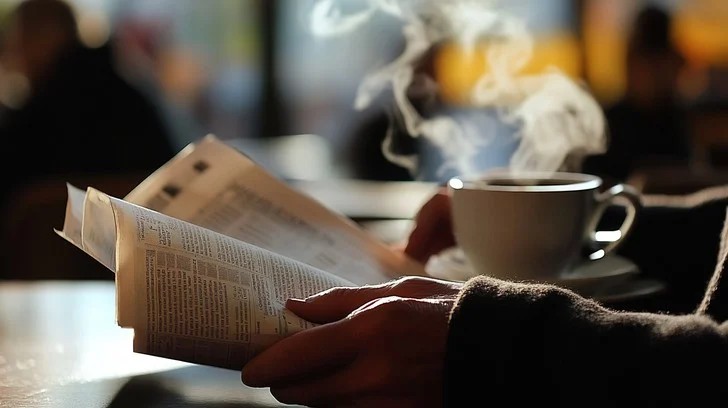
If I could do it all again, I’d be a journalist—back when reporters smoked pipes, wore cardigans, and called in breaking news from pay phones.
Journalism runs in my family. My uncle Rudy Taylor, cousin Andy Taylor, and cousin Jenny (Taylor) Dively have owned, written for, and edited several newspapers in southeastern Kansas. I’ve always been a little jealous of them—except on deadline day.
I miss newspapers. Not so much the black smudge they left on my fingers when I read them front to back, but the moments they made me feel like I was a participant in the world and its events.
It startles me now when I see someone reading one. Newspapers take up so much space and require special folding skills—unless you have a desk to lay them flat, with the front page finally turned, revealing pages 2 and 3 like a secret.
Growing up in Bartlesville, if you made it into the Examiner-Enterprise, you’d get your picture laminated by the local funeral director, Arnold Moore, sent with a note to your home by mail. I always thought this to be strikingly premature to send to a kid. But the point is, what an honor to have your picture in the newspaper. Now, our kids have thousands of images of themselves. Ubiquity surely dilutes the prestige of moments. I can count the pictures I’ve seen of my four great-grandfathers on one hand. I have a thousand pictures of my granddaughter.
I started most days of my life after college by buying a paper and reading it with a cup of coffee. I’ve started many fires with newspapers too—some literal, some metaphorical.
When I was a graduate student at Harding University, I had the financial resources of a turnip. So I saved fifty cents a day by reading the Arkansas Gazette on a stick at the public library. One of my favorite authors, Charles Portis—the quiet genius behind True Grit—once wrote for that same paper.
In honor of Charles Portis, a journalist at heart, here are a few of my favorite lines from his books:
“But I had not the strength nor the inclination to bandy words with a drunkard. What have you done when you have bested a fool?” True Grit
“You do not think much of me, do you, Cogburn?”
“I don’t think about you at all when your mouth is closed.” True Grit“On his deathbed he asked for a priest and became a Catholic… If you had sentenced one hundred and sixty men to death and seen around eighty of them swing, then maybe at the last minute you would feel the need for some stronger medicine than the Methodists could make.” True Grit
“The big problem was the typing. When you run up against a policeman at a typewriter, you might as well get a Coke and relax.” ― Charles Portis, The Dog of the South
At Portis funeral in Little Rock on February 28, 2020, Ernie Dumas recalled a fellow Gazette reporter, Patrick J. Owens, who came to the paper around 1959, the same era of Portis journalistic career, writing for the Gazette.
“Owens was a Gazette reporter who came from Hungry Horse, Montana,” Dumas said. “He was brilliant and a great writer. He took notes with those big brown No. 2 pencils. When he finished, he stuck the end of the pencil against his chest and guided it down into his shirt pocket. By the end of the day, the top of his shirt would have dozens of black marks above his pocket. You can imagine what his shirt was like by the end of the week.”
Wouldn’t it be great to have a shirt as evidence of your creative forces? To wear it in public and have folks stare at the residue of your passion—writ carbon to cloth.
Portis understood that world and lived it. He understood something rare: the gravity of history and the absurdity of living in it. He wrote about real things with a straight face and a wry smile.
If I could go back, I’d chase stories with a notebook and a deadline—and maybe a pipe in my pocket. I’d walk into newsrooms where people still yelled “Copy!” and it was hard to think absent the din of a dozen smoking-hot typewriters.
And somehow, I’d know that what we put in print would stain fingers—and stay in minds—a little while longer than today’s world of endless digital ephemera.
I think about all this sometimes when I remember reading the paper in the library. There was usually an older man there, like the one I imagine here, by the name of Ed. A man of quiet grace, perhaps a professor—bow tie, tweed jacket, and the kind of permanent squint that suggested he was always thinking.
It is 1986, my pinnacle year of reading free newspapers in public libraries. Reagan is in the White House, and Gorbachev is still mostly a curiosity in the World section. Ed and I have a conversation. We sit at the long oak table, reading newspapers affixed to those wooden rods.
Me:
Ed, you ever stop to think how strange it is to read the news on a stick?
Ed:
It’s orderly. Civilized. And prevents malcontents from absconding with the daily news.
Me:
True. But do you think anyone will remember these times—when we read news on a wooden pole and hoped nobody stole the sports page?
Ed:
Probably not. But what may be strange is that one day, the news will always be fresh. If the Soviets move a million troops to the Mongolian border, we won’t have to wait for the morning edition to find out.
Me:
Good point.
Ed:
Newspapers are always a day behind, you know. The obits are even more outdated. I’ve seen friends in the obits—dead for a week. There has to be a timelier way. But newspapers will always be there for us. I mean… what happens if one day there are no newspapers? No newsboys yelling on the corners, no editors tapping cigars in the newsroom, no clatter of the press?
Me:
A world without print? That’s like saying people won’t write letters anymore.
Ed:
Well, one day mainframe computers will shrink, and we’ll have news on a screen. Instant. Global. No smudged ink. No folded pages. Imagine that—news without the rustle.
Me:
Now that sounds odd. What’s the news without the feel of the paper? The coffee ring on the comics section? The crossword penciled in and marked out by wanna-be wordsmiths?
Ed:
Exactly. Without the newspaper, how do you sit with the news? You’d just skim headlines without a jacket or tie, maybe in your pajamas, never brushing shoulders with another reader.
Me:
There’s something real about paper and ink. Tactile. Solid. True. You read the same ink a thousand others read that morning. It’s a quiet, common communion of citizens.
Ed:
One day, this old stick may seem quaint—like quill pens and parchment. Maybe the news will be piped straight into your ears. No pages, no editorials, just a feed of… whatever someone thinks you want to hear.
Me:
God help us if the future confuses what we want to hear with what we need to hear.
Ed:
Amen to that.
We both nod and turn a page.
 Bespoke