I remember walking the halls of my old grade school in my early twenties when I was busily fulfilling the truth of George Bernard Shaw’s old saw, “Youth is wasted on the young.” The halls had mysteriously shrunk but the place still smelled of pine-scented cleaner on polished linoleum. They tore the school down in 2008, replacing it with Armstrong Bank.
I thought of my old school as I walked into the lobby of Armstrong Bank recently and heard the echoes of a familiar tune: “Hey, look us over, Limestone is here…” Until that moment, I had never realized that our Limestone School Alma mater tune was a cover of the song made famous by Louis Armstrong, “Hey, Look Me Over.” How fitting that a bank bearing the Armstrong name now stands where my childhood school once did, its foundation resting upon the very stones that held seven years of my earliest memories.
My first-grade teacher, Mattie Mayberry, inaugurated the WPA-built version of Limestone School when it opened in 1939. The clock in her classroom moved at a glacial pace, its hands seemingly frozen above the chalkboard as I wondered if time was simply standing still.
I often felt like it was wasted time. What did I truly learn at my school?
“I before E except after C”?
When the wrecking ball caved in the walls of my old school, I felt a tinge of sorrow. I asked permission from Armstrong Bank to go to the site and salvage a few stones as mementos. If walls talked, those weathered stones would tell stories of learning that went beyond textbooks.
They would speak of the physics of a Tetherball accelerating around a pole, its decreasing orbit creating the illusion of increased speed.
They would whisper about the mysteries of space and sound, children talking and laughing during recess on the playground, how we turned our faces to the sky when sonic booms rattled our ears, scanning the clouds for the contrails of Air Force jets as we played kickball.
They would tell of the dignity and kindness of my fourth-grade teacher, Mrs. Karbosky. Her reading glasses hung from a silver chain around her neck, and she addressed us with precise diction and perfect posture. Her favorite phrase was, “Class, please give me your undivided attention.” I was intimidated by her until the day my grandfather died. She pulled me aside and told me how sorry she was for my loss.
And then there was the day I thought she would say no. In the fall of 1968, my St. Louis Cardinals were locked in a heated World Series battle against the Detroit Tigers. Stan Baughn and I approached her desk, hesitantly asking permission to listen to the game on the radio. Day games were the norm back then. To our astonishment, she said yes. We huddled in the back of the classroom with my transistor radio, hanging on every word as Harry Caray and Jack Buck called the game.
Our sports teams at Limestone School did not travel great distances to compete like today’s youth teams. We walked through the oil fields to play football against Wayside School or our parents drove us to Highland Park School for basketball games. I remember taking a shot from the top of the key, only to have the ball hit the ceiling. Mr. Tyner, our principal and coach, just shrugged and said that was why he always shot underhanded—granny-style, as we called it—to compensate for low ceilings. Mr. Tyner was the first authority figure in my life who made me feel truly seen. After school, I would stay in the gym shooting baskets and he would talk with me. I knew he had my best interests at heart.

Not all teaching came from pedigreed teachers. Rusty Mathews, our janitor, kept cinnamon and butterscotch candies in a coffee can in his supply closet. He was part Santa Claus, flinging treats to students, and part guardian angel, always watching over us. Rusty knew most of our parents, which was another reason to stay on the straight and narrow—though he still managed to catch me red-handed a few times. He embodied kindness and quiet grace. The world would be better if every child had a janitor like Rusty.

Limestone School was also where I first grappled with the fragility of life. Not only did I lose my grandfather, but a schoolmate drowned in an icy pond. I barely knew David, but sometimes when I drive Silver Lake Road near that fateful spot, I think of him and his family. In that moment, even as children, we confronted mortality and the weight of grief.
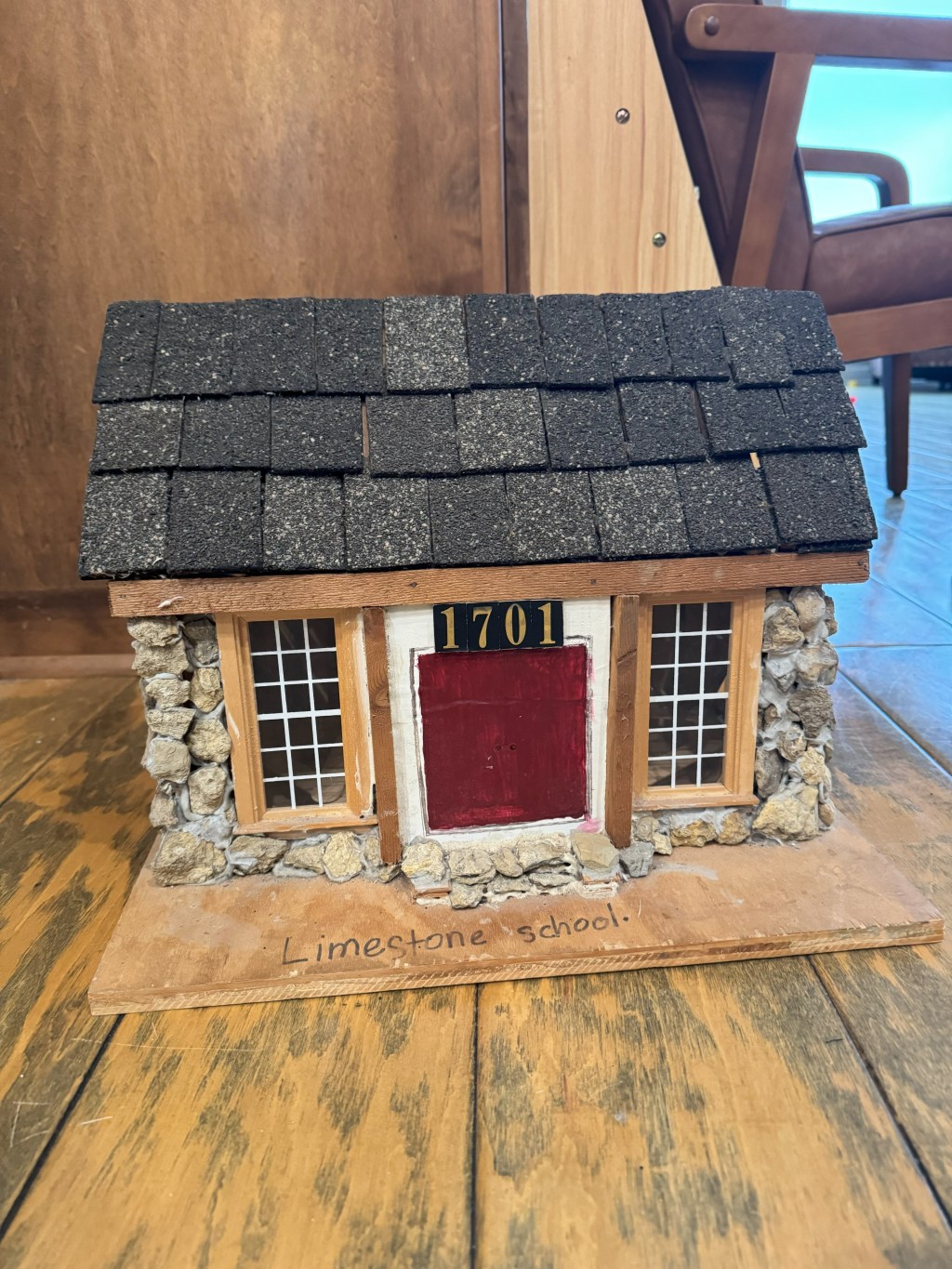
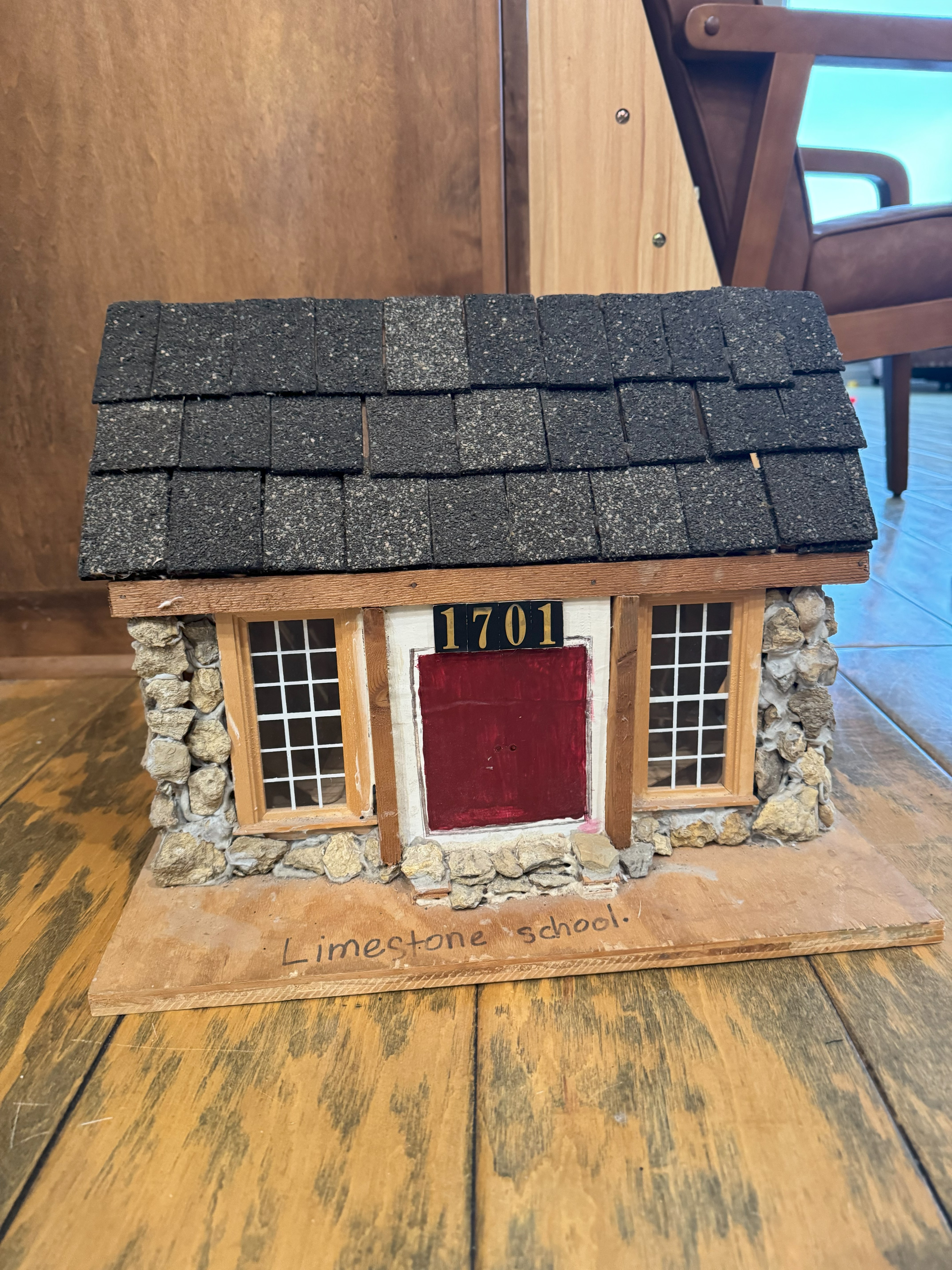
When my eldest daughter was attending grade school, she had a building project that I helped her with. It was a mock-up of Limestone School. We gathered stones from a field just south of where Limestone School stood. We purchased wood, windows, and doors from Hobby Lobby, and took a few shingles from one of my home-building job sites. It was so heavy, I’m not sure how she ever turned it in for credit. Last week, Lauren was rummaging through our attic and found it.
So, I did learn a few things in grade school. They gave me a certificate when I graduated, but I lost it somewhere along the way. I wonder what else I’ve lost from those days. I had no way of knowing that I would lose my school, that it would be demolished. If I had known, it would have bothered me. But on that final day of grade school, I walked across the playground, down to the crosswalk, turned north toward home, and never looked back.
Stephen King wrote in Stand By Me, “I never had any friends later on like the ones I had when I was twelve.” And I never had another school like Limestone.


 Bespoke
Leave a reply to Caleb Cheruiyot Cancel reply